Buying web design leads sounds convenient, but it usually creates two problems. First, the lead quality is inconsistent. Second, the agency still has to do the hardest part manually: deciding whether the business is actually a good design fit.
That is why many agencies eventually stop buying lists and start building their own local prospecting system instead.
The strongest web design leads usually have three things in common:
- the website problem is visible
- the business is commercially active
- the agency can explain the upside of fixing the site
If you can search for those signals repeatedly, you do not need to buy generic lead packs.
Start with a narrow market
Web design prospecting gets easier when the market is specific.
"Need more web design leads" is too broad. Better inputs look like:
- builders in Bristol with outdated websites
- dental clinics in Leeds with weak mobile UX
- accountants in Manchester with slow, brochure-style sites
This is where discovery-first systems beat generic lists. They start with a market definition instead of a spreadsheet.
If your team is still shaping that process, read how web design agencies can generate leads faster first.
Look for visible design problems
The best web design leads are not random businesses with an email address. They are businesses where the design problem can be seen quickly.
Useful signals include:
- dated layouts
- poor mobile experience
- hard-to-find calls to action
- missing service pages
- weak trust sections or outdated branding
- websites that feel abandoned
That gives the agency a reason to contact the prospect. Outreach is much stronger when it starts with "here is what we noticed" instead of "we build websites."
Use KeywordIQ to build the list
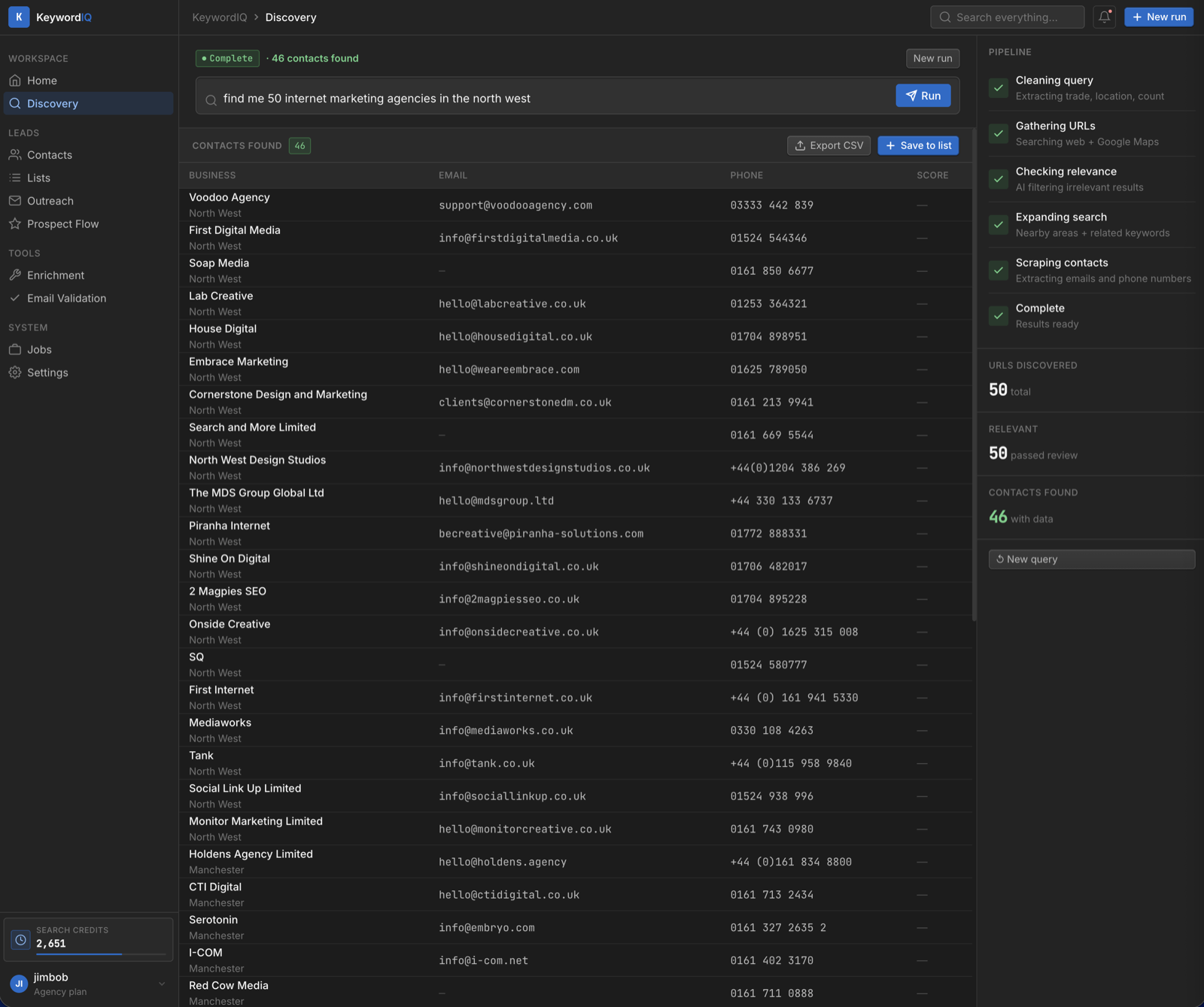
KeywordIQ is useful here because the app mirrors how design agencies actually prospect.
Start with AI Discovery and prompt the market you want. A good example would be:
- "25 electricians in Birmingham with outdated websites"
- "30 estate agents in Leeds with weak mobile sites"
- "20 local trades businesses in Liverpool with poor website UX"
Once the job runs, review the results inside the app and shortlist the businesses where the design gap is obvious. Then:
- save the best fits into Contacts
- keep wider research buckets in URL Lists
- enrich missing details if you need a cleaner contact path
- move the strongest prospects into Outreach
That creates a much cleaner workflow than buying a list first and diagnosing later.
Build outreach around the problem
Many agencies lose good leads because the email is too generic.
A better structure is:
- one observation about the current site
- one commercial implication of that issue
- one low-friction next step
For example, a design agency does not need to send a long proposal to first contact a business. It just needs to show that it understands the problem clearly.
This is one reason how to find local business leads with AI works so well as a companion process. Better targeting makes better outreach possible.
Repeat the workflow weekly
The real advantage of not buying leads is that you build a repeatable pipeline. Each search teaches the agency something:
- which niches respond well
- which cities are too competitive
- which website problems are easiest to sell against
- which offers get the best reply rates
That feedback loop is hard to build with prepackaged lead sources. It is much easier when the discovery prompt, the review logic, and the outreach handoff all live in one workflow.
What to avoid
Do not make the mistake of targeting every weak website you can find. Design agencies still need fit.
Avoid markets where:
- budgets are obviously too small
- the business looks inactive
- there is no clear commercial upside to a redesign
- the agency cannot explain a specific problem quickly
Sharper lists usually outperform larger ones.
Try KeywordIQ free
If you want a repeatable system for finding and qualifying UK web design leads, start with lead generation software for agencies or Start free and run a focused local market.
FAQ
Should web design agencies buy leads?
They can, but many agencies get better results when they build their own lists around visible website problems and local-market fit.
What makes a strong web design lead?
A strong lead has a visible website issue, a real commercial reason to improve it, and a business profile that matches your agency's offer.
How many leads should a small agency target each week?
Usually a smaller, better-qualified batch works best. A list of 20 to 40 strong-fit businesses is often more useful than a large generic list.