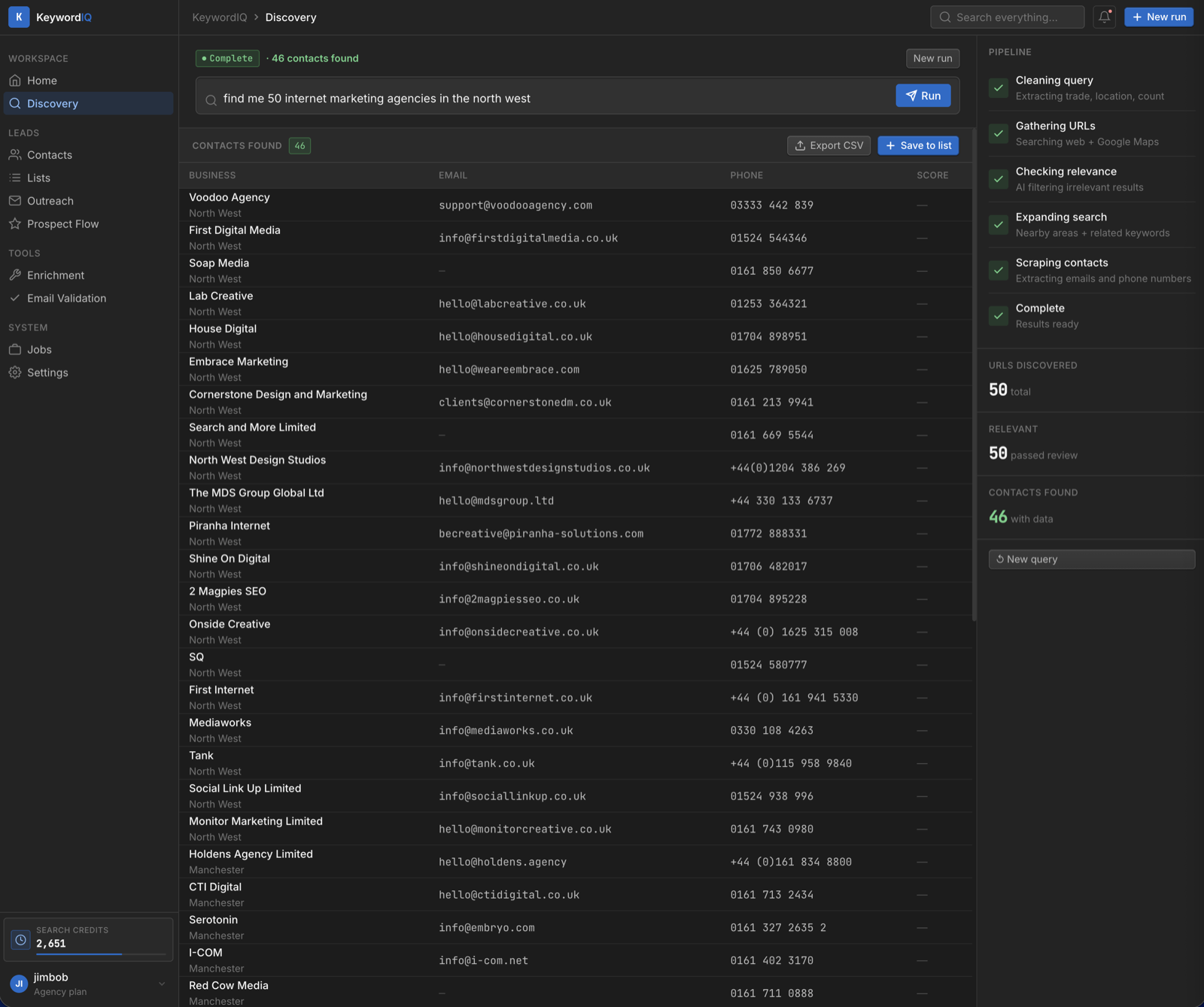
Most lead generation workflows break in the handoff. Discovery happens in one tool, qualification happens in notes, the list lives in a spreadsheet, and outreach starts after half the context has already been lost. The fix is not more tools. It is a cleaner sequence.
For agencies, the most practical workflow is simple: define the market, discover candidates, qualify fit, save the strongest leads, and then move into outreach with the reasoning still attached.
Step 1: define the target market
Every strong workflow starts with a narrow market definition. That means a business type, a location, a signal of fit, and a target count.
This is why how to find local business leads with AI starts with prompt quality. The workflow becomes much more efficient when the target is specific.
Step 2: discover candidates from live signals
The discovery stage should find real businesses in the market, not just export a generic category list. For many agencies, this is where live web data becomes more useful than static databases.
The discovery step should produce:
- a clear list of candidate businesses
- enough context to judge whether they belong in the funnel
- a clean path into qualification
Step 3: qualify before you save
Qualification is where agencies protect their time. Not every business in the market deserves outreach.
Judge each candidate based on:
- offer fit
- geography
- website quality or visible need
- usable contact pathway
This is also the stage where lead generation software for agencies should prove its value. If the software cannot make qualification easier, it is only solving part of the problem.
Step 4: turn qualified results into outreach-ready lists
Once leads are qualified, the system should make it easy to organize them. That might mean saved contacts, lists, exports, or a campaign queue. The important part is preserving why the lead was saved.
That makes outreach sharper because the team is no longer starting from a blank slate. The list already contains the context that justified the prospect.
Step 5: outreach with context, not templates alone
The strongest outreach is built on the discovery work. The message should reflect the reason the business was chosen, not just a generic service pitch.
That is the advantage of a connected workflow. Discovery improves qualification. Qualification improves outreach. Outreach then becomes more relevant because it is built on a stronger lead source.
FAQ
What is the most common workflow mistake?
Losing context between stages. Teams discover leads, export them, and then recreate the reasoning later instead of preserving it from the start.
How many stages should the workflow have?
Only the stages that matter: target definition, discovery, qualification, list building, and outreach handoff.
Does every agency need the same workflow?
No, but most agencies benefit from the same sequence even if the qualification rules differ by service or market.