If you are searching for a Bark alternative, you are usually not just looking for a cheaper source of leads. You are looking for more control.
That is the real issue with marketplace-style lead generation. It can create activity fast, but it rarely gives an agency an owned prospecting system. You respond to demand that appears inside someone else's platform, often under time pressure, and the lead quality depends on how well the marketplace matches the request to your offer.
For many UK agencies, that works at the start. It becomes less attractive once the team wants a more predictable pipeline, stronger qualification, and leads that are not trapped inside a pay-to-contact model.
Why agencies start looking for an alternative
Bark can be useful when an agency wants quick access to inbound demand. But many teams eventually hit the same limits:
- the agency is reacting instead of targeting
- the best-fit prospects are mixed with weak-fit requests
- the workflow depends on fast response rather than deliberate qualification
- the agency does not build a reusable list it fully owns
That last point matters most. A strong pipeline is an asset. If your lead generation resets every time you stop buying introductions, you do not really have a pipeline. You have a rented channel.
What a better alternative should do
A better Bark alternative should help you generate your own opportunities instead of waiting for them to appear.
For an agency, that usually means:
- defining a niche or local market clearly
- discovering businesses from live public web signals
- reviewing website quality and service fit before outreach
- saving strong matches into a reusable list
- turning qualified leads into outreach campaigns
That is much closer to an operating system than a marketplace. It is also why what is AI lead generation software? is a useful question to answer before buying any new tool.
Exclusive leads beat shared urgency
Marketplace leads push agencies into speed. Discovery-first systems push agencies into fit.
Fit usually wins over time.
If your team sells web design, SEO, PPC, or broader digital marketing services, the strongest prospect is rarely "whoever posted a request first." It is usually a business with a visible gap you can diagnose and explain:
- weak or outdated website
- poor local search visibility
- missing service pages
- thin trust signals
- unclear contact paths
That is why discovery-first prospecting often converts better. The outreach begins with an observation, not a scramble.
How KeywordIQ works as a Bark alternative
KeywordIQ is built around the workflow agencies usually want after they outgrow lead marketplaces.
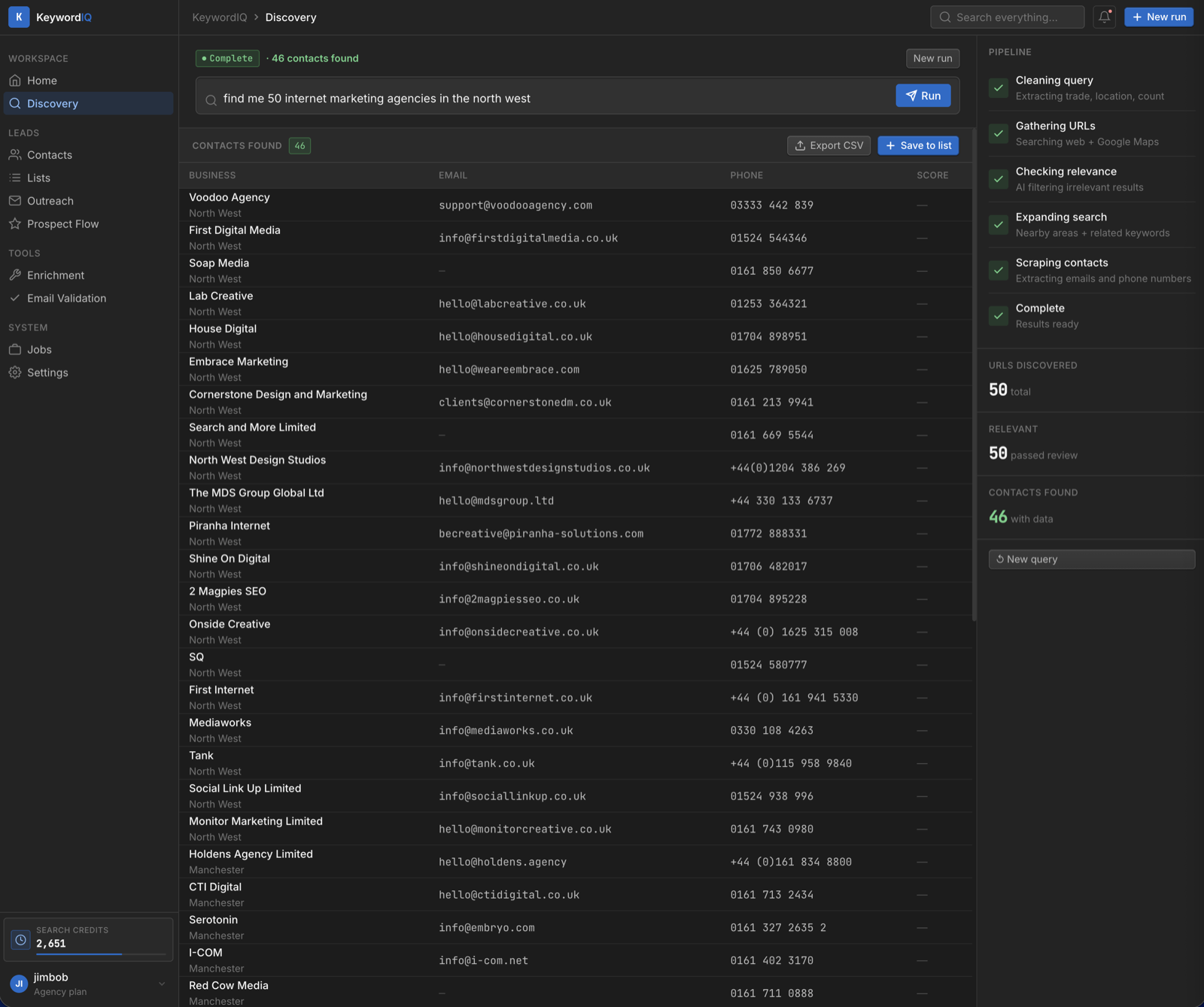
Instead of waiting for a marketplace request, you start with AI Discovery. A plain-English prompt such as "20 plumbers in Manchester with outdated websites" or "roofers in Leeds with weak SEO signals" becomes an active job inside the app.
From there, the workflow is practical:
- run AI Discovery against the market you actually want
- review the businesses returned by the job
- save the strongest matches into Contacts or URL Lists
- enrich missing business data where needed
- move the shortlist into Outreach or Prospect Flow
That changes the sales motion. You are no longer paying to react to generic demand. You are building a list of businesses that already fit your offer.
This is also why how to build a lead generation workflow from discovery to outreach is so important. The workflow matters as much as the lead source.
When a Bark alternative becomes the obvious choice
Agencies usually make the switch when one of these becomes true:
- they want more predictable lead quality
- they are tired of lead-by-lead economics
- they want reusable lists they can revisit later
- they need better local-market targeting
- they want outreach context before first contact
At that point, a marketplace is no longer solving the right problem. The agency does not need more alerts. It needs better market control.
A practical migration path
You do not need to switch everything at once. A better move is to replace one slice of your pipeline first.
For example:
- choose one service line, such as web design or local SEO
- choose one city or region
- run one repeatable discovery prompt each week
- save and score the best leads
- compare reply quality against your marketplace leads
That gives you a clean test. If the owned pipeline produces sharper conversations, you have the evidence you need to expand it.
Try KeywordIQ free
If you want a Bark alternative built around owned discovery, qualification, and outreach, start with AI lead generation software or go straight to Start free and run your first market.
FAQ
Is Bark bad for agencies?
Not necessarily. It can be useful for agencies that want immediate marketplace demand. The limitation is that it does not create an owned, repeatable discovery system.
What is the main difference between Bark and KeywordIQ?
Bark centers on paid introductions from customer requests. KeywordIQ centers on discovering and qualifying your own target market from live public web signals.
Who benefits most from switching away from Bark?
Agencies that sell recurring services into local businesses usually benefit the most, especially web design, SEO, and digital marketing teams that want better fit and more control.