An Apollo alternative for UK agencies should solve a slightly different problem than Apollo itself. Agencies selling into local businesses do not just need contacts at scale. They need fresher market discovery, better website-level context, and a workflow that helps them decide which businesses are worth contacting.
That is why many agencies end up looking beyond database-first tools. Local prospecting often depends on live public web signals, business websites, and service relevance. If the workflow starts and ends with a static record, the team still has to do the hardest qualification work manually.
The commercial page for Apollo alternative explains the product positioning. This article explains the buying logic behind it.
Why local agencies look for an alternative
Apollo is strong for many outbound use cases, but local agencies often want:
- current business websites they can review
- evidence of service fit beyond job title data
- discovery in local or niche geographic markets
- a direct handoff into lists and campaigns
Those requirements are different from classic B2B outbound. A local SEO agency does not just want "marketing manager in the UK." It wants local businesses with visible demand, weak websites, or weak local search presence.
The database-first limitation
Database-first tools can be fast, but they also create a hidden cost: the team still has to prove whether a lead is worth pursuing. That usually means checking the website, checking the location, checking the offer fit, and checking whether the business is active enough to matter.
If those steps stay manual, the database saves time at the beginning but not necessarily across the full workflow. That is why posts like web scraping for lead generation: benefits and risks matter. They show where live web discovery can create a better starting point.
What a stronger alternative looks like
A stronger alternative usually starts with live discovery rather than static lookup. The software should help you define the market, find active businesses, gather current context, and organize the strongest leads into a repeatable system.
That is the model behind AI lead generation software for agencies. The goal is not to replace judgment. It is to make the discovery and qualification path much faster.
Where KeywordIQ fits
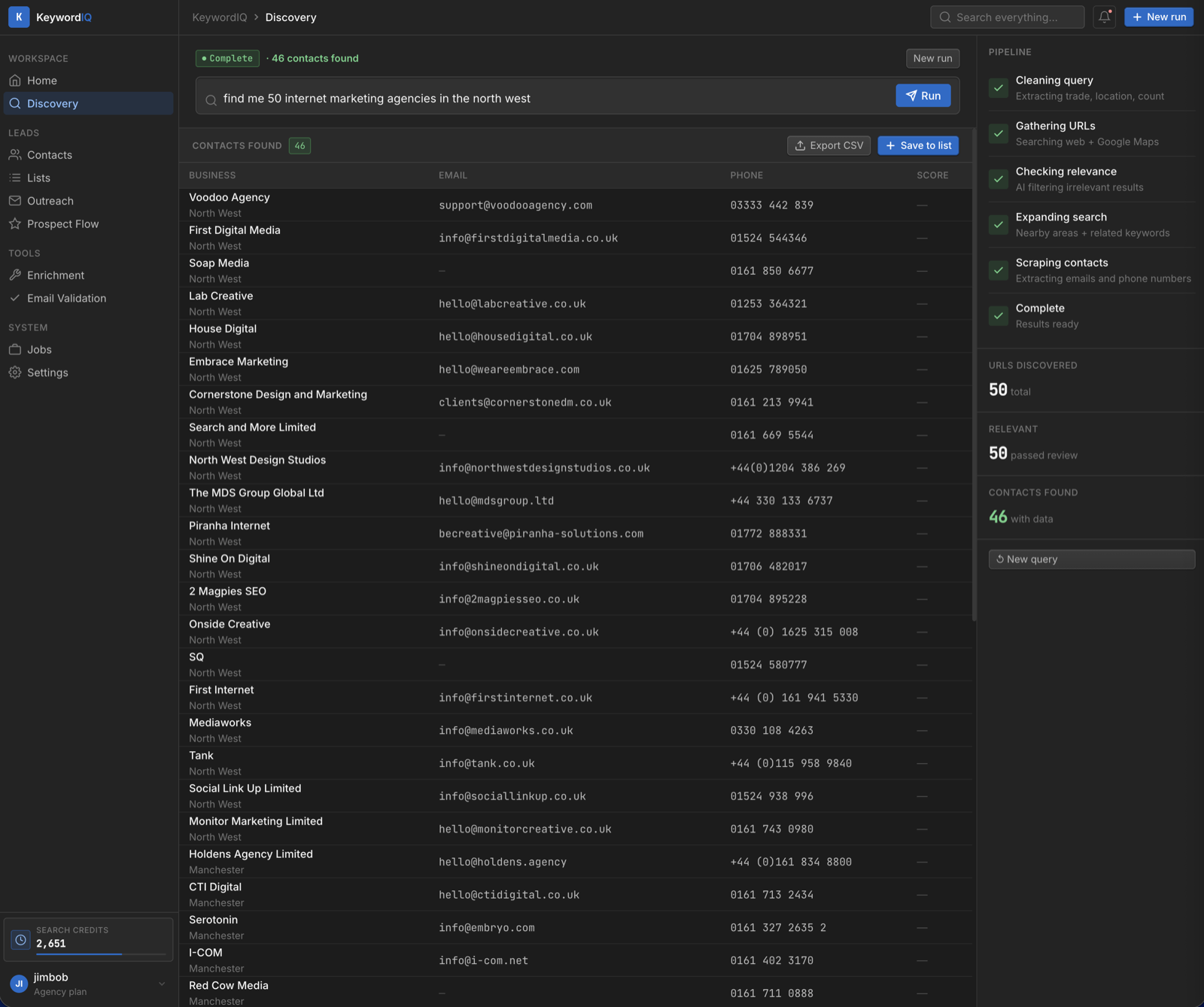
KeywordIQ is designed for agencies that prospect into local business markets. The discovery flow starts with a prompt, not a manual list build. Results are then organized around qualification and next actions.
For teams that care more about freshness and website context than about raw database volume, that is often a better fit than an all-purpose contact warehouse.
FAQ
Is Apollo bad for agencies?
No. It is simply optimized for a different style of outbound than many local-service agencies need.
Why does UK agency prospecting need a different workflow?
Because local markets rely heavily on business websites, service context, and geography. Those signals are often easier to discover from live public web data than from a static contact record.
What should I compare when looking for an Apollo alternative?
Compare freshness, local-market discovery, qualification support, and how easily the software moves results into outreach-ready workflows.